


Why Play-Based Learning Is the Foundation of Lifelong Success

If there’s one message I could shout from the rooftops to every parent, carer, and educator, it’s this: play is not a luxury - it’s essential. Play-Based learning Is the foundation of lifelong success.
In our achievement-driven world, where flashcards for toddlers and early literacy targets have become the norm, we’re in danger of overlooking the most powerful and natural tool we have for early development: play.
Far from being frivolous, play is the foundation of lifelong success.
The Brain Thrives on Play
Play is not downtime for the brain - it’s primetime. Neuroscientists have found that during play, the brain’s prefrontal cortex - the centre for decision-making, planning, and problem-solving - is highly active. Research by the Harvard Center on the Developing Child shows that executive function skills (like memory, self-regulation, and flexible thinking) are deeply nurtured through play.
When a child is immersed in imaginative play, building a block tower, or role-playing in a pretend café, they are laying down the neural foundations for future learning. They’re learning to focus, manage frustration, follow a plan, and adjust when things don’t go as expected. These are not just “nice to have” skills - they’re the cognitive backbone of everything from academic achievement to mental wellbeing.
“Play is the work of the child.” - Maria Montessori

Real-World Problem Solving Through Play Based Learning
Whether it’s figuring out how to keep a cardboard den from collapsing, working out who gets the red spade in the sandpit, or trying to build a rocket out of sofa cushions - play teaches problem-solving in the most engaging, self-directed way.
And that’s the key: self-direction. When adults step back, children become the engineers, storytellers, planners, and fixers. They test ideas, make mistakes, regroup, and try again. This fosters perseverance, critical thinking, and the kind of real-world problem-solving that no worksheet can replicate.
Taking Risks, Building Confidence
Play also helps children develop an understanding of risk. Not the unsafe, scary kind - but the calculated, empowering kind. Think about a child climbing higher on a climbing frame than they’ve ever gone before. Their heart races, their body learns its limits, and their confidence grows.
Outdoor play, in particular, supports physical literacy and self-awareness. It teaches children to navigate uneven ground, respond to physical challenges, and assess danger for themselves - crucial life skills that build resilience and independence.
A 2020 study by The LEGO Foundation found that risk-taking in play enhances children's confidence and ability to manage uncertainty, which has long-term benefits for emotional health and adaptability in adulthood.

Social Skills and Emotional Intelligence
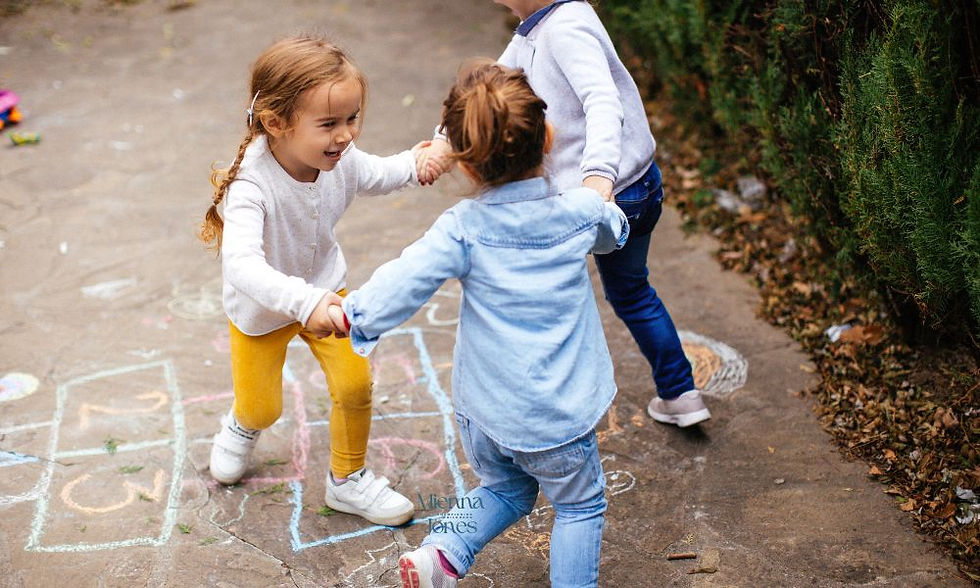
When children play together, they learn how to communicate, collaborate, and resolve conflict. Through imaginative play, they take on roles, express emotions, and understand the feelings of others. “You be the baby and I’ll be the doctor” may sound simple - but underneath it lies deep empathy-building.
Children develop:
Emotional regulation (e.g., calming themselves when they don’t get their way)
Negotiation skills (e.g., deciding who plays what role)
Leadership and compromise (e.g., guiding play while including others)
These “soft” skills are increasingly recognised as core competencies in the workplace. According to a 2023 report from the World Economic Forum, emotional intelligence and adaptability are among the top skills needed for success in the 21st century.
The Danger of Rushing Learning
In many countries, including the UK, there is pressure for children to achieve academic milestones earlier and earlier. But this comes at a cost. Over-formalising early education - especially before the age of seven - can lead to stress, disengagement, and a lack of motivation.
Compare this with play-centred systems like Finland’s, where formal learning begins at age seven. There, children spend their early years in environments rich in play, nature, and creative freedom. The outcome? High levels of literacy, numeracy, and wellbeing - with far less burnout.
Play Is the Foundation, Not a Break
Play is not a break from learning—it is learning.
It develops the whole child:
Cognitively, by wiring the brain for learning
Emotionally, by building resilience and regulation
Socially, by nurturing cooperation and empathy
Physically, by strengthening coordination and risk awareness
As early years practitioners, educators, and parents, we must champion play as essential, not optional. By creating time, space, and trust for children to play, we allow them to grow into confident, capable, connected human beings.
Final Thoughts
The question isn’t “should we prioritise play?” It’s “how can we afford not to?”
Every time we step back and allow children the freedom to play, we’re giving them something profound - the tools to think, to feel, to relate, and to thrive.
At Mienna Jones Consultancy, we work with early years settings, parents, and professionals to help build environments where play isn’t squeezed in around the edges - it’s front and centre.
Let’s protect childhood. Let’s trust play. Because in play, children find not just joy - but the roots of everything they will one day become.
Ready to Talk?
Whether you’re seeking guidance as a parent, training for your team, or a trusted consultant to help grow your setting, Mienna would love to support you.
Mienna Jones, Championing Childhood
📞 Call us: 07359 380484
📧 Email us: hello@miennajones.com
🌐 Visit: www.miennajones.com
📰 Join our mailing list: Sign up here


Comments